Iran Supreme Leader Killed in Joint US-Israeli Strikes as Tehran Retaliates
Coordinated daylight assault on Tehran plunges the region into wider conflict following the death of Ayatollah Ali Khamenei.

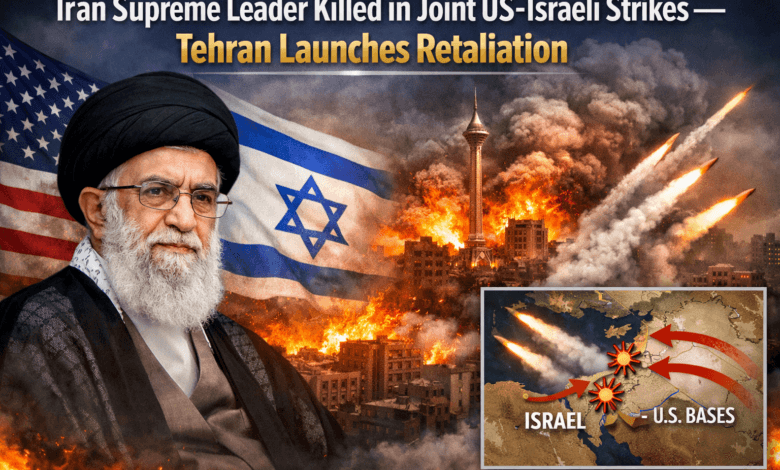
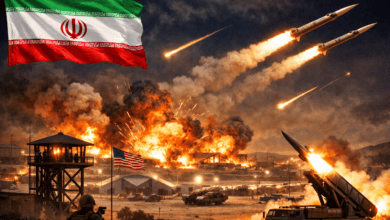
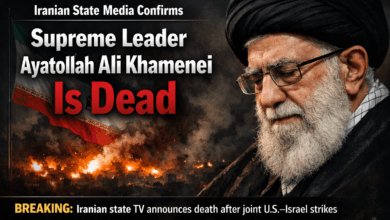
In an unprecedented escalation of Middle Eastern hostilities, a coordinated US-Israeli daylight operation on Saturday resulted in the death of Iranian Supreme Leader Ayatollah Ali Khamenei. The strike, which targeted high-level command centers in Tehran, has triggered immediate and massive retaliatory missile barrages from Iran against Israeli medical facilities and military installations across the region, effectively plunging the world into the early stages of a wider regional war.
The joint operation, confirmed by sources at both the Pentagon and the Israeli Defense Forces (IDF), marks a definitive turning point in the decades-long shadow war between the nations. For the first time, the United States and Israel have directly targeted the spiritual and political heart of the Islamic Republic, leading to a volatile power vacuum in Tehran and sparking fears of a total collapse of regional stability.
The Daylight Assault on Tehran
The operation commenced in the early hours of Saturday, involving stealth aircraft and precision-guided munitions that bypassed Iran’s sophisticated air defense systems. According to military analysts, the strike specifically targeted a high-security bunker where Khamenei was reportedly meeting with senior members of the Islamic Revolutionary Guard Corps (IRGC). The devastation was absolute, with PBS reporting that the strike also claimed the lives of several top generals and scientists, totaling at least 78 deaths and hundreds of injuries.
The sheer audacity of a daylight strike on a sovereign capital has sent shockwaves through the international community. “This was not a tactical strike; this was a decapitation of the regime,” says Dr. Elias Thorne, a senior fellow at the Strategic Studies Institute. “By removing the Supreme Leader, the US and Israel have crossed a historical red line, leaving no room for diplomatic retreat.” arn more about previous escalations in the Persian Gulf.
Tehran Launches Massive Retaliation
Tehran’s response was swift and uncompromising. Within hours of the news of Khamenei’s death, Iran launched waves of ballistic missiles and suicide drones aimed at major Israeli cities and US assets in the Middle East. Al Jazeera reported that Supreme Leader-designate and other hardline figures in the IRGC vowed that the response would not be “half-measured,” declaring that “Tehran will burn, but Tel Aviv will be extinguished.”
One of the most alarming developments occurred in southern Israel, where an Iranian missile reportedly struck a major hospital. The New York Times confirmed that civilian casualties are mounting as the IDF’s Iron Dome system struggled to cope with the sheer volume of incoming projectiles. Iranian state media has framed these attacks as a direct eye-for-an-eye response to the loss of their leader, ignoring international calls for restraint.
Trump’s High-Stakes Gamble
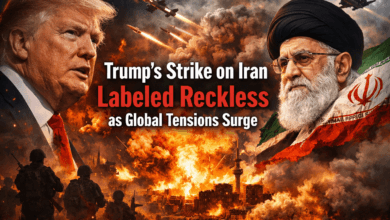
In Washington, President Donald Trump is facing intense scrutiny over his role in authorizing the joint strike. Reports from Bloomberg suggest that Trump is wagering this aggressive posture will revitalize his domestic agenda, framing the conflict as a necessary step to secure American interests and permanently disable Iran’s nuclear ambitions. However, the President has kept the world guessing on his next move, stating he will decide on the full extent of the U.S. role in the conflict within “two weeks.”
Critics argue that the move is a desperate attempt to save a flailing MAGA agenda. Reuters noted that while some supporters cheer the elimination of a long-time adversary, others fear the economic and human costs of a protracted war. “The President is gambling with global security to bolster his polling numbers,” remarked one congressional insider on the condition of anonymity.
Global Panic and Humanitarian Crisis
As the battle escalates, civilians in both Iran and Israel are being urged to evacuate target areas. The G7 summit, currently in session, has become a frantic hub of emergency diplomacy, though Iran has reportedly refused all ceasefire talks while the strikes on its soil continue. The humanitarian situation is deteriorating rapidly; with hospitals under fire and infrastructure crumbling, the United Nations has warned of a looming catastrophe if a ceasefire is not reached immediately.
According to CNBC, global markets have reacted with extreme volatility, as oil prices surged to record highs on fears of a closure of the Strait of Hormuz. International carriers have suspended all flights to the region, and several nations have begun emergency evacuations of their citizens from neighboring countries like Lebanon and Jordan.
Read More: ইরানে হামলার পর মধ্যপ্রাচ্যের মার্কিন ঘাঁটিতে ইরানের পাল্টা ক্ষেপণাস্ত্র হামলা
Expert Analysis on a Looming Total War
Military experts suggest that the conflict has entered a “new and unpredictable phase.” The death of Khamenei removes the ultimate arbiter of power in Iran, potentially giving rise to a military junta led by the IRGC. “We are looking at a scenario where the internal power struggle in Iran could lead to even more radical actions, including the use of any remaining unconventional weapons,” says military historian Sarah Jenkins. For more live updates, visit Reuters World News.
As the sun sets over a smoke-filled Tehran and a battle-worn Israel, the question is no longer whether there will be a war, but how long it will last and who will be left to sign a peace treaty. The international community remains on high alert, waiting to see if President Trump’s two-week window will bring a diplomatic miracle or a final declaration of total war.