Samsung Galaxy S26 vs Apple iPhone 17: The Ultimate 2026 Flagship Battle
The tech industry reaches a fever pitch as Samsung and Apple unveil their most innovative premium smartphones to date.

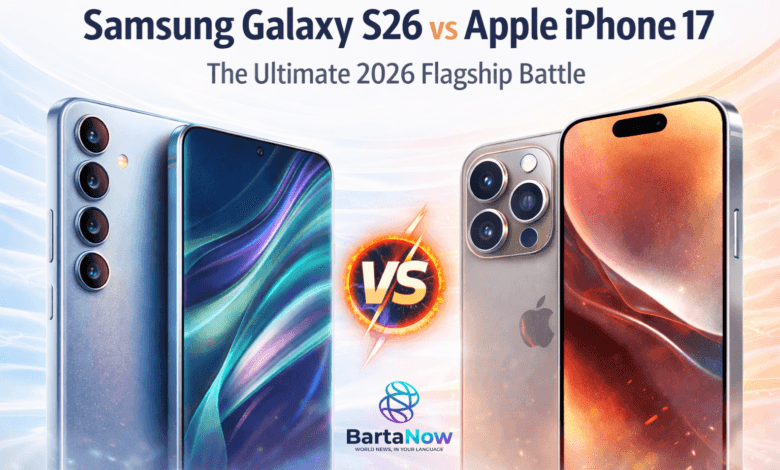
The smartphone landscape enters a new era in early 2026 as Samsung unveils the Galaxy S26 series, directly challenging Apple’s iPhone 17 lineup in a high-stakes battle for premium market dominance. This clash of titans highlights significant leaps in generative AI, display privacy, and hardware efficiency. With both companies pushing the boundaries of what a handheld device can achieve, consumers are faced with a choice that defines their digital lifestyle for the next several years. The ‘Battle of the Premium Phones’ is no longer just about megapixels; it is about who provides the most seamless, secure, and intelligent user experience.
The Privacy Revolution: Samsung’s Spy-Level Display
One of the most talked-about features of the new Samsung Galaxy S26 Ultra is the inclusion of what industry experts are calling ‘Spy-Level’ technology. According to reports from PCMag, Samsung has introduced a Privacy Display that utilizes specialized nano-optics to narrow the viewing angle. This ensures that only the person directly in front of the device can see the content on the screen, a feature designed for the modern professional who often works in public spaces or travels frequently. While Apple has long focused on software-based privacy, Samsung is taking a hardware-first approach that could redefine consumer expectations for data security on the go.
Design Evolution: The iPhone 17 Slim vs Galaxy S26 Ultra
Apple is rumored to be shaking up its design language significantly with the iPhone 17 lineup. Reports suggest the introduction of a new ‘iPhone 17 Slim’ or ‘Air’ model that prioritizes a razor-thin profile without sacrificing performance. Furthermore, Apple is expected to finally bring 120Hz LTPO ProMotion displays to the entire iPhone 17 range, moving away from the standard 60Hz screens that have lagged behind competitors for years. Samsung, meanwhile, continues to refine its ‘Ultra’ aesthetic with a titanium frame and a slightly more ergonomic curve, ensuring that despite its large screen, the device remains comfortable for long-term use and S Pen productivity.
The AI Arms Race: Galaxy AI vs Apple Intelligence
Artificial Intelligence remains the primary battlefield for 2026. The Samsung Galaxy S26 is powered by the Snapdragon 8 Gen 5 for Galaxy, a chip specifically engineered to handle massive on-device AI workloads. This allows for real-time video translation during calls, proactive health monitoring, and generative photo editing that can recreate missing parts of an image with startling accuracy. Apple is counter-attacking with a deeper integration of Apple Intelligence into iOS 19, focusing on private cloud compute and a more conversational Siri that can perform complex actions across third-party apps. As noted by a lead analyst at Gizmochina, ‘The battle between Samsung’s Galaxy S26 Ultra and Apple’s iPhone 17 Pro Max represents the highest level of smartphone competition in 2026.’
Camera Systems: Optics and Computational Power
For many enthusiasts, the camera remains the deciding factor. The Samsung Galaxy S26 Ultra is rumored to retain its dominance in long-range photography with an improved 200MP main sensor and a dual-telephoto setup that offers 100x Space Zoom with significantly reduced noise. Apple, however, is closing the gap by upgrading its front-facing camera to 24MP and potentially introducing a 48MP telephoto lens across the Pro models to match its main sensor’s resolution. This move aims to provide consistent color and detail regardless of which lens the user chooses. You can see how this compares to previous generations in our Samsung Galaxy S25 review, where the foundation for these upgrades was first laid.
Performance and Pricing Predictions
Performance benchmarks suggest that the A19 Pro chip in the iPhone 17 will continue to lead in single-core efficiency, making it the champion for mobile gaming and video editing. However, the Galaxy S26’s massive 16GB of RAM allows for superior multitasking and smoother AI performance. Pricing is expected to remain premium, with analysts from Meyka predicting that both flagships will start at approximately $1,199 for their ‘Ultra’ and ‘Pro Max’ variants. Investors are watching closely, as the success of these devices will likely dictate market trends for the entire mobile sector throughout the second half of the decade.
Ultimately, the choice between the Samsung Galaxy S26 and the Apple iPhone 17 depends on whether you value the open, feature-rich innovation of Android or the polished, integrated simplicity of the iOS ecosystem. Both devices represent the pinnacle of engineering, proving that while the smartphone market may be maturing, there is still plenty of room for revolutionary technology that changes how we interact with the world around us.