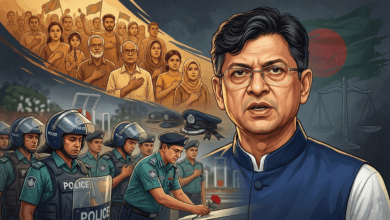
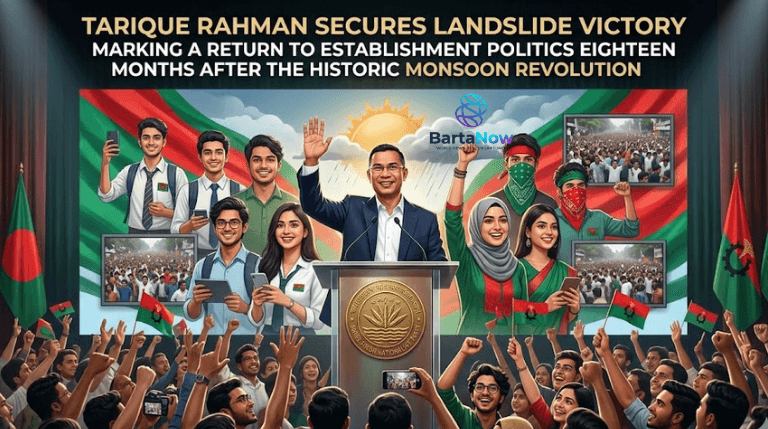
On February 12, 2026, the Bangladesh Nationalist Party (BNP) achieved a decisive landslide victory in the nation’s first general elections since the 2024 uprising, signaling a shift back to traditional power structures despite the revolutionary fervor that ousted Sheikh Hasina. The election, characterized by a massive turnout and supervised by a neutral interim framework, saw Tarique Rahman emerge as the presumptive Prime Minister, ending nearly two decades of exile and political marginalization.
The Return of the Establishment
The results, announced early Monday morning, confirmed that the BNP and its allies secured a two-thirds majority in the Jatiya Sangsad. While the 2024 “Monsoon Revolution” was driven by a student-led coalition demanding a total “democratic reset,” the electorate ultimately leaned toward the organizational depth and name recognition of the BNP. For many voters, the promise of economic stability and a return to institutional normalcy outweighed the untested radicalism of the nascent student parties.

According to Muhib Rahman, a senior fellow at Perry World House, the results reflect a classic political pendulum swing. “While the students broke the old system, they lacked the grassroots machinery to build a new one in time for the 2026 polls,” Rahman noted. “The BNP successfully framed themselves as the only viable force capable of managing the post-revolutionary transition.” This sentiment was echoed in urban centers where voters prioritized the rising cost of living over abstract reforms.
Gen Z and the NCP: A Hard Lesson in Realpolitik
The most striking narrative of the 2026 cycle is the performance of the National Citizen’s Party (NCP), the political wing of the student protesters who toppled the Awami League. Despite their role in the uprising, the NCP managed to secure only six seats in the parliament. This “crushing at the ballot box” has sparked a debate about the difference between street mobilization and electoral endurance. For more context on the transition of student power, see our analysis of the 2024 protest movements.
The youth vote, which was expected to be a monolithic block for change, fragmented across several smaller platforms. Analysts suggest that the BNP’s superior campaign financing and local-level influence allowed them to dominate rural constituencies where the student message of “systemic overhaul” failed to resonate as strongly as promises of immediate infrastructure development and agricultural subsidies.
The Shadow of ‘Revenge Politics’
One of the primary concerns for international observers is whether the new government can break the cycle of revenge politics that has plagued Bangladesh for decades. With the Awami League largely absent from the ballot or running under independent banners, there are fears that the BNP victory might lead to a purge of the old guard. Chatham House experts have warned that a “democratic reset” is only possible if the incoming administration avoids the temptation of judicial retaliation against political rivals.
Tarique Rahman, speaking from the party headquarters in Dhaka, addressed these concerns by promising a government of national unity. “We are not here to seek vengeance, but to rebuild a nation that was systematically hollowed out,” Rahman stated. However, critics point to the swift reorganization of local police and administrative posts as evidence that the party is already moving to consolidate its grip on the state machinery.
Unresolved Issues: The Economy and the Rohingya
The new government inherits a nation facing severe economic headwinds. High inflation, depleting foreign exchange reserves, and a frustrated garment sector are at the top of the agenda. Furthermore, the Rohingya crisis remains a geopolitical stalemate. Both the BNP and the NCP had highlighted the need for repatriation in their manifestos, but the ground reality in Myanmar offers little hope for a quick resolution. Environmentalists have also voiced frustration, noting that the major manifestos focused on industrial growth while largely ignoring the climate vulnerability of the Delta region.
As Bangladesh enters this new era, the world watches to see if the landslide mandate will be used to strengthen democratic institutions or if it will simply replace one dominant power structure with another. For now, the streets of Dhaka are quiet, but the expectations of the 2024 generation remain high, and any failure to deliver on the promise of transparency and justice could reignite the very forces that brought the BNP back to power.